
XGIMI MoGo 4 Laser vs Nebula Capsule 3 Laser
Both put a laser projector, speaker, streaming system, and battery into a small body. Room light, setup space, travel weight, and app needs decide which tradeoffs matter.
By Adam Anderson, Editor and CEO
This article contains paid Amazon links. Gearsentials may earn a commission from qualifying purchases. Affiliate standards.
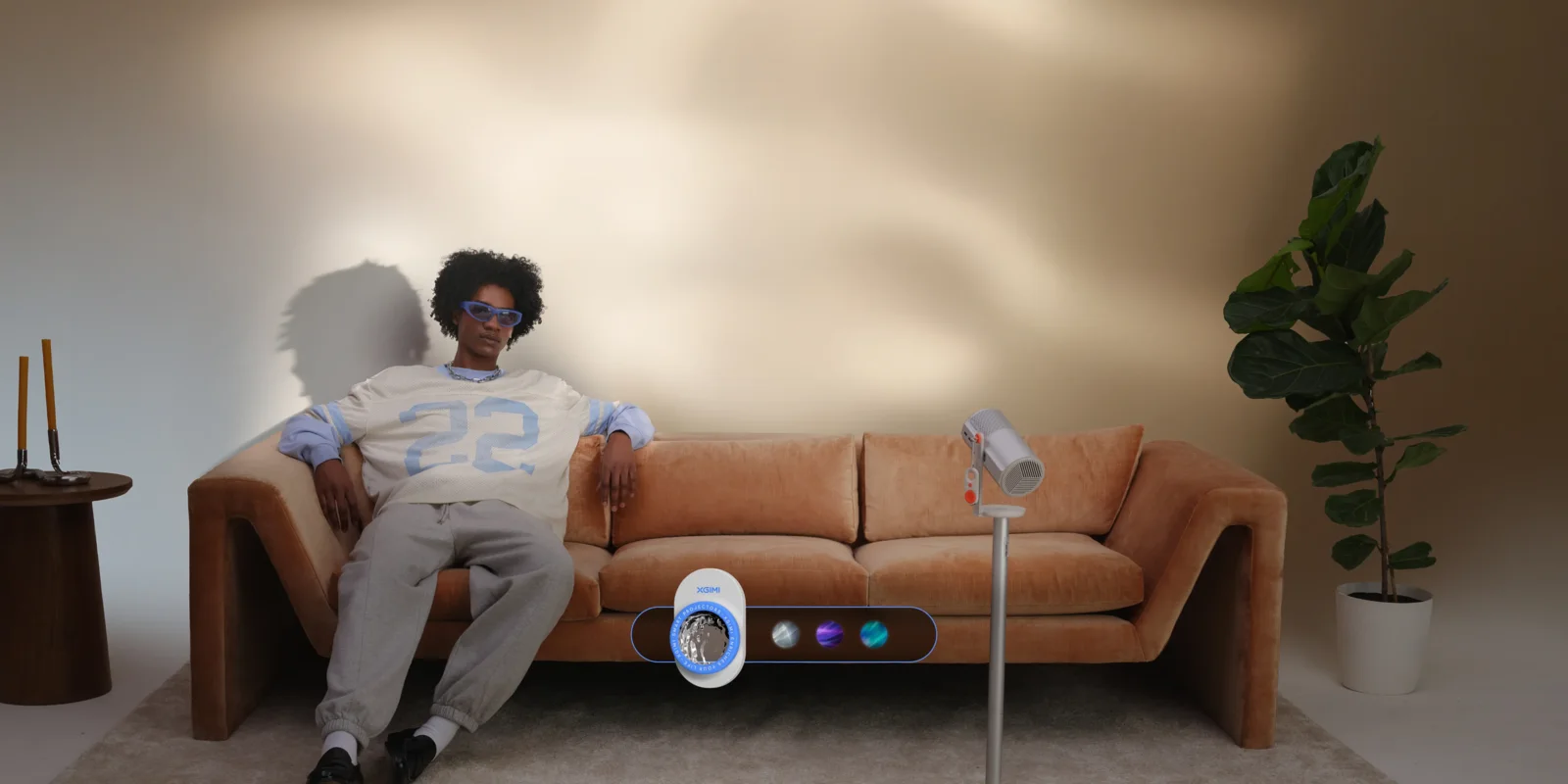
MoGo 4 Laser vs Capsule 3 Laser: what changes the purchase
| Check | XGIMI MoGo 4 Laser | Nebula Capsule 3 Laser | Buying consequence |
|---|---|---|---|
| Exact child | B0F3C2XFKR | B0BCWNQPQ7, Google TV offer | Avoid mixed parent listings and old software stock |
| Native resolution | 1920 × 1080 | 1920 × 1080 | Both are 1080p projectors, not native 4K |
| Published brightness | 550 ISO lumens | 300 ANSI lumens | Don’t calculate a percentage from different labels |
| Independent picture verdict | Stronger contrast and wider gamut | Less striking in the matched dark-room test | XGIMI is the movie-image pick |
| Published image range | 60–120 inches recommended | 40–120 inches | Larger images become dimmer |
| Battery | 71.28Wh; up to 2.5 hours in Eco | 52Wh; up to 2.5 hours in Eco | The headline runtime isn’t full brightness |
| Weight | 2.9 lb | About 2.1 lb | Nebula saves roughly 0.8 lb |
| Positioning | Integrated rotating stand | Tripod or stand sold separately | XGIMI is easier to aim out of the box |
| Speakers | 2 × 6W Harman Kardon | 8W Dolby Digital | Published wattage doesn’t prove better sound |
| Storage | 32GB | 16GB | XGIMI leaves more room after the operating system |
| Software | Google TV; licensed Netflix | Current exact offer: Google TV; licensed Netflix | Older Capsule 3 Laser stock may be Android TV |
| Audio output | HDMI ARC; no listed 3.5mm jack | HDMI ARC and 3.5mm output | Nebula is simpler with wired external audio |
Compare the exact standalone models
Paid links. Gearsentials may earn a commission from purchases.
Best for: XGIMI when the integrated stand and stronger dark-room image justify the extra size; Nebula when packability wins. Skip if: The listing changes to a bundle, refurbished unit, regular Capsule 3, or Android TV version.
The brightness numbers don’t support a percentage claim
XGIMI publishes 550 ISO lumens. Soundcore publishes 300 ANSI lumens. Both standards use screen measurements, but there’s no defensible fixed conversion for turning these two product-page figures into “XGIMI is X percent brighter.” Keep the units attached and use independent tests for the practical answer.
That answer is less exciting than the marketing: both need a fully dark room. RTINGS found the XGIMI more striking because of contrast and color gamut, not because a calculator transformed one brightness label into the other. For either projector, a smaller image, darker room, and neutral surface will do more than an inflated maximum-size claim.
XGIMI wins the dark-room movie decision
The XGIMI's advantage isn’t native resolution; both are 1080p DLP projectors. It’s the image those pixels produce under the conditions where mini projectors make sense. In RTINGS' matched comparison, the MoGo 4 Laser delivered much better contrast and a wider color gamut. That should matter for movies with dark scenes and saturated color.
Neither should be bought for headline HDR support. Both can process HDR material, but limited light output caps the visual impact. Both use native 1080p display systems, not native 4K panels. Verify compatibility with the exact external source you plan to connect because the brands don’t document every input combination consistently.
Nebula is easier to pack; XGIMI is easier to place
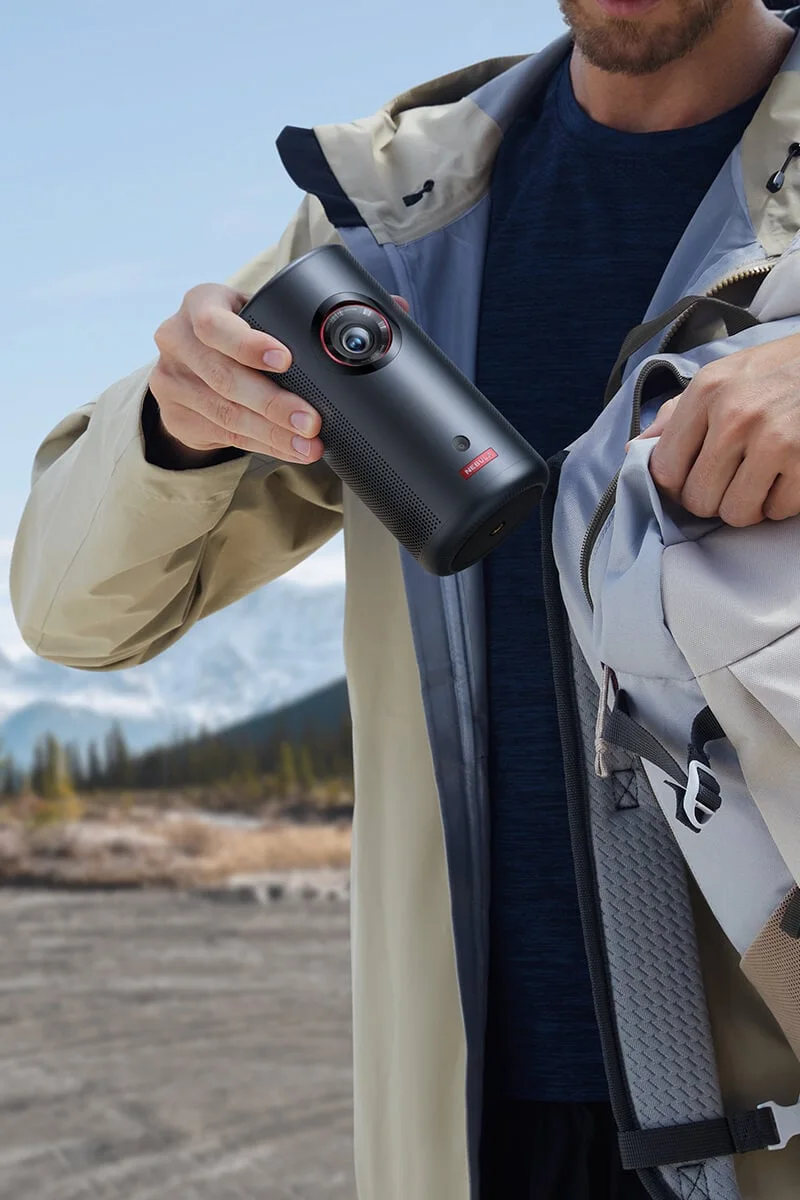
Capsule 3 Laser is the travel winner on physical size. Soundcore lists it at roughly 2.1 pounds and 3.3 inches across by 6.7 inches tall. The MoGo 4 Laser is about 2.9 pounds and 3.8 inches across by 8.2 inches tall. That difference is meaningful in a backpack, especially after adding power, a remote, and cables.
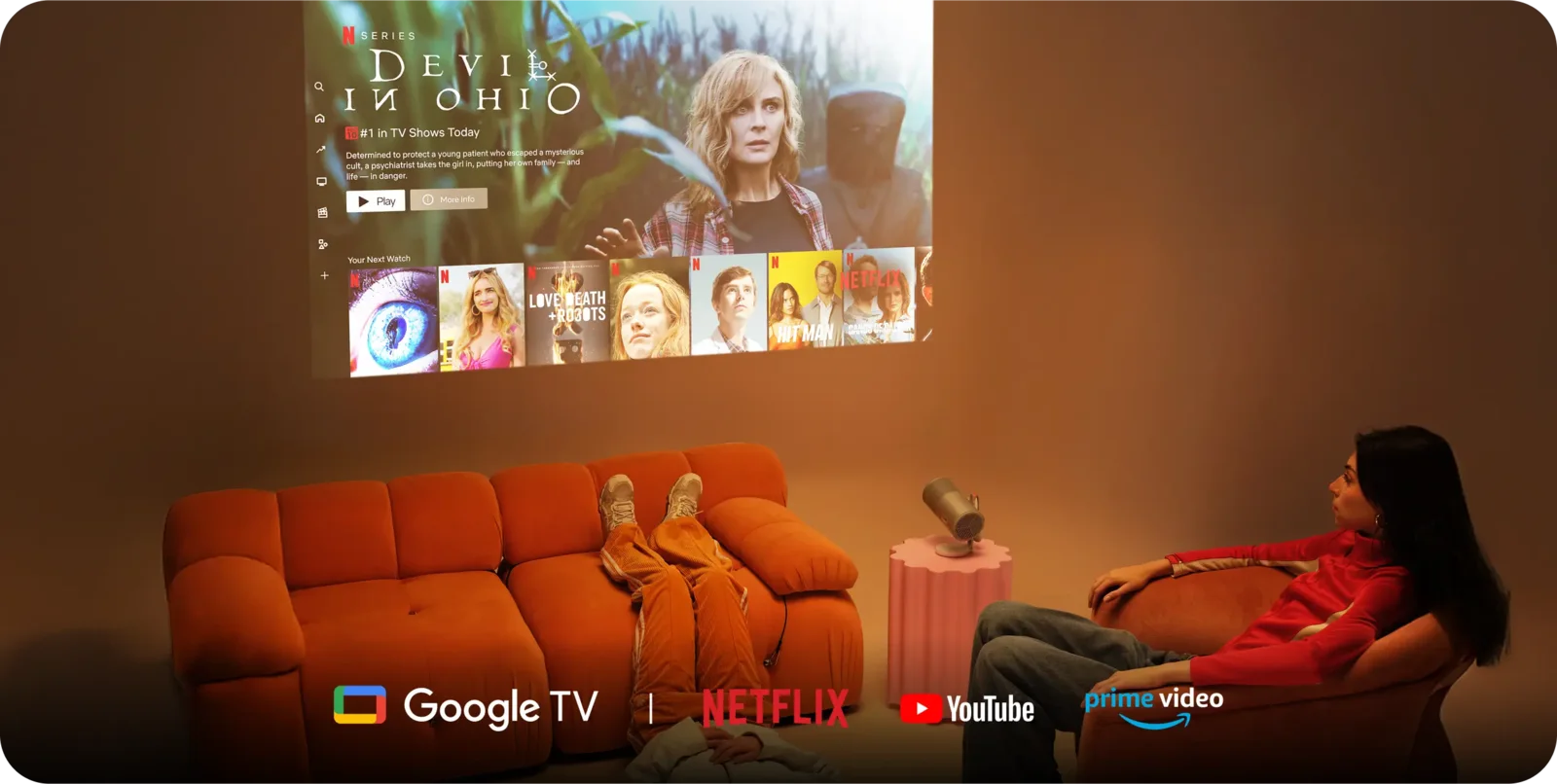
XGIMI earns some of that volume back in the room. Its projector body rotates through the integrated stand, so it can aim at a wall or ceiling without a separate mount. Capsule 3 Laser can auto-focus and correct keystone, but angling the cylinder still requires a stable surface or a separate tripod or stand. Digital keystone also reshapes the image by using fewer pixels, so better physical placement remains preferable.
The 2.5-hour battery claim means Eco mode
Both brands advertise up to 2.5 hours of video, and both attach that figure to an Eco mode. It isn’t a promise of maximum light output for a full feature-length movie. Soundcore's own support table lists Capsule 3 Laser at 250 lumens for about 1 hour 40 minutes in Standard mode and 130 lumens for about 2 hours 30 minutes in Eco.
Independent results reinforce the tradeoff. ProjectorCentral measured lower Capsule output on battery, while Expert Reviews recorded 1 hour 53 minutes from the XGIMI in Standard mode. The practical plan is to use a wall outlet when picture brightness is the priority and treat the battery as convenience for a darker, lower-output setup.
Both accept USB-C Power Delivery, but requirements matter. XGIMI calls for a compatible 65W-to-150W source at 20V. Soundcore recommends at least 45W with PD 2.0 and a 5V-to-20V range. A random phone battery pack isn’t automatically sufficient.
Confirm the Google TV Capsule, not just the product name
MoGo 4 Laser has Google TV and licensed Netflix. Capsule 3 Laser needs more attention because the hardware name spans software generations. Original D2426 units shipped with Android TV 11. Anker later released a Google TV version and says the older Android TV model can’t be converted to it.
The current US Soundcore page even contains both generations of copy: Google TV and licensed Netflix appear near the top, while an older Android TV section remains farther down. The Amazon button on this page targets the exact child that currently says Google TV and Netflix. Before checkout, confirm those words in the selected configuration instead of relying on pooled reviews or the parent product page.
Gaming results conflict, so neither earns a gaming recommendation
Manufacturer and independent lag results point in different directions. XGIMI publishes a low game-mode figure with automatic keystone disabled, while RTINGS measured much higher lag and rated the projector poorly for gaming. ProjectorCentral measured roughly 22-to-24ms from Nebula in HDMI Game mode, but RTINGS also found the Capsule's lag high.
The honest conclusion is narrower: either can handle a movie or a casual, turn-based game, but neither is the right recommendation for competitive play. The room-light limitation also remains; low lag doesn’t make a dim portable projector suitable for a sunny gaming room.
Audio and ports favor different setups
XGIMI publishes two 6W Harman Kardon speakers, compared with Nebula's 8W Dolby Digital system. We haven’t listened to them, and wattage alone doesn’t establish volume, clarity, or bass. Nebula does have a 3.5mm audio output that can be simpler for powered speakers or headphones.
Both provide HDMI with ARC, USB-A, and USB-C charging. Neither USB-C port should be treated as a video input; use HDMI for a console, laptop, or external streamer. XGIMI lists 32GB of storage versus 16GB for Nebula, which leaves more space for apps and cached data after system files.
Which portable laser projector should you buy?
Buy XGIMI MoGo 4 Laser for dark-room movies
It has the stronger matched picture evidence, the integrated rotating stand, more storage, and a larger battery. It’s the better default when the projector moves around a home more often than it rides in a bag.
Buy Nebula Capsule 3 Laser for a smaller travel kit
It’s the better fit when saving roughly 0.8 pound and reducing packed volume matters more than the XGIMI's image and placement advantages. Confirm the exact Google TV child and account for a stand when the projection angle requires one.
Skip both when the room can’t get dark
A television or brighter plug-in projector is the more honest recommendation for daytime sports, lights-on family viewing, or a permanent living-room screen. Portability doesn’t repeal the light requirements of projection.
The verdict
XGIMI MoGo 4 Laser is the better buy for most movie-first users. Its dark-room image tested better, and its integrated stand turns setup into one object instead of a projector-plus-tripod problem.
Nebula Capsule 3 Laser remains the more packable alternative. Buy it when size, weight, wired audio output, or a materially better exact offer outweigh the picture difference. Whichever one you choose, budget for darkness and treat 2.5 hours as an Eco-mode ceiling—not the brightness you saw in a product-page hero. Tiny projectors still need a dark room; marketing hasn't repealed physics.
Choose the exact current projector
Paid links. Gearsentials may earn a commission from purchases.
Best for: XGIMI for the better movie-first setup; Nebula for the lighter travel kit. Skip if: The selected listing changes to a bundle, refurbished unit, older software version, or seller and fulfillment path you don’t trust.
FAQ
Which is better, XGIMI MoGo 4 Laser or Nebula Capsule 3 Laser?
The XGIMI is the better default for movies in a fully dark room. Independent matched testing found stronger contrast and a wider color gamut, and its integrated rotating stand makes placement easier. Choose the Nebula when its smaller, lighter body or a materially lower exact offer matters more.
Can either portable projector work in daylight?
Neither is a daylight projector. Independent testing found both too dim for ambient-light use. Treat outdoor projection as a dry, after-dark activity and keep the image closer to the manufacturers' practical ranges instead of chasing the largest advertised size.
Is 550 ISO lumens directly comparable with 300 ANSI lumens?
No fixed conversion should be applied. The manufacturers publish different measurement labels, so the numbers don’t justify a percentage brightness claim. Use controlled independent testing for the practical conclusion: both need darkness, while the XGIMI produced the stronger dark-room picture in RTINGS' matched test.
Do both projectors really last 2.5 hours on battery?
Both companies frame 2.5 hours as an Eco-mode maximum, not full-brightness runtime. Soundcore's support table lists shorter Capsule 3 Laser runtime in Standard mode, and an independent XGIMI test also fell short of 2.5 hours in Standard mode.
Does every Nebula Capsule 3 Laser have Google TV?
No. Older Capsule 3 Laser units used Android TV 11, and Anker says they can’t be converted to Google TV. Confirm that the exact child offer says Google TV and licensed Netflix; don’t rely on the shared Capsule 3 Laser name alone.
Are these native 4K projectors?
No. Both projectors have native 1920-by-1080 displays. Manufacturer language about 4K decoding or compatibility isn’t documented consistently enough to promise that every 4K source will work, so verify the exact source and connection you plan to use.
Are these good gaming projectors?
They are safer for movies and casual or turn-based games than serious gaming. Independent input-lag results conflict, and RTINGS didn’t recommend either as a gaming projector. A dedicated low-lag projector or television is the better choice for competitive play.
Sources
- XGIMI MoGo 4 Laser product page and current gallery
- XGIMI detailed specifications, ports, battery, and setup functions
- soundcore Capsule 3 Laser specifications and current software claim
- soundcore projector battery modes and power-bank requirements
- Anker Japan Capsule 3 Laser Google TV generation documentation and gallery
- RTINGS direct standardized comparison
- ProjectorCentral Capsule 3 Laser measurements and battery testing
- Expert Reviews MoGo 4 Laser battery and gaming context