
Canon EOS R50 V vs Sony ZV-E10 II
These cameras both target people who film themselves, but their kits, crops, ports, and lens systems pull them in different ways. The right pick depends on how you shoot now and what you may add later.
By Adam Anderson, Editor and CEO
This article contains paid Amazon links. Gearsentials may earn a commission from qualifying purchases. Affiliate standards.
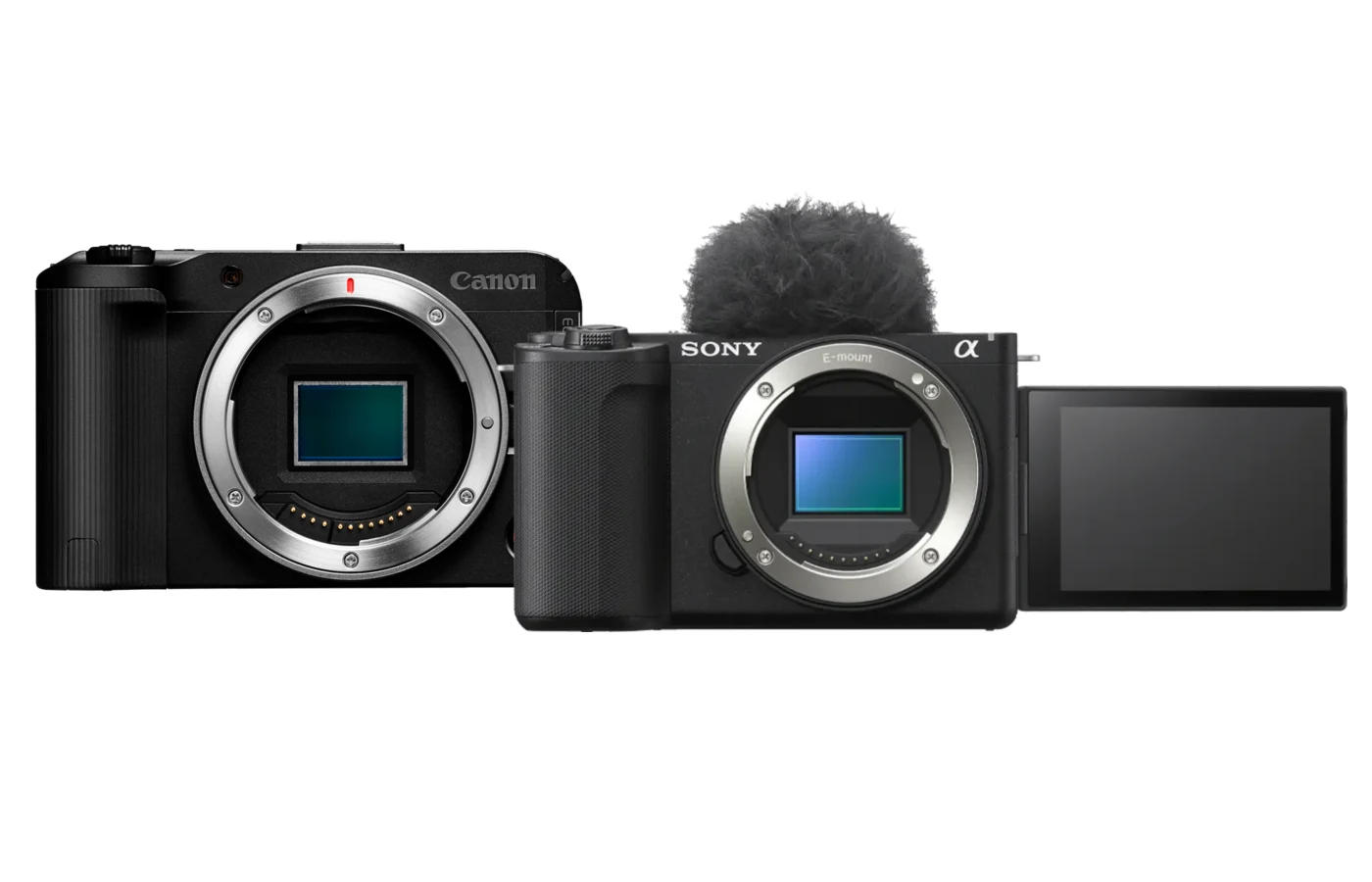
Canon R50 V vs Sony ZV-E10 II: the useful differences
| Check | Canon EOS R50 V | Sony ZV-E10 II | Buying consequence |
|---|---|---|---|
| Sensor | 24.2MP APS-C; RF mount | 26MP APS-C; E mount | The small resolution gap isn’t a useful quality verdict by itself |
| 4K through 30p | Full-width, oversampled from 6K | Full-width, oversampled from about 6K | Both provide the cleaner wide-view mode for ordinary creator work |
| 4K50/60 | About 1.56x extra crop; not oversampled | About 1.1x extra crop; oversampled from about 5.6K | Sony is much easier for arm's-length 4K60 |
| 4K100/120 | Not available | Free Sony camera-upgrade license; about 1.6x extra crop | Sony adds slow-motion headroom, but the mode gets tight and loses Active stabilization |
| Stabilization | Lens IS plus Movie Digital IS; no IBIS | Lens OSS plus Active electronic mode; no IBIS | A lens, tripod, gimbal, or careful technique still matters |
| Factory kit lens | RF-S 14–30mm F4–6.3 IS STM PZ | E PZ 16–50mm F3.5–5.6 OSS II | Canon starts wider; Sony reaches farther |
| Official battery figures | LP-E17; up to 480 power-saving stills | NP-FZ100; about 610 stills and 130 min actual movie | Sony is the safer battery choice away from power |
| Body-only weight | Approx. 323g | Approx. 292g | Sony is lighter, but the attached lens and support gear decide the carried kit |
| Vertical production | Side tripod socket, rotating UI, vertical orientation metadata | Rotating UI, no side tripod socket | Canon is easier to mount natively for 9:16 production |
| Included with body | Battery, external charger, strap, body cap | Battery, strap, wind screen and adapter, body cap | Canon includes charging hardware; Sony includes a wind screen |
| Viewfinder / IBIS | Neither | Neither | A hybrid stills camera or stabilized body may be a better purchase |
The 4K60 crop changes the decision
“Shoots 4K60” doesn’t tell you how much of the room remains in frame. Canon says its 4K crop mode retains 64% of the horizontal angle of view used for stills. Dividing by 0.64 gives an extra crop of about 1.56x. That sits on top of Canon's normal 1.6x APS-C field-of-view conversion.
Sony's 4K50/60 mode uses roughly a 1.1x extra crop beyond its normal 1.5x APS-C view. Independent DPReview analysis also found that Sony oversamples this mode from about 5.6K, while Canon's cropped 4K60 mode isn’t oversampled.
Approximate widest 4K60 view with each factory kit
Canon: about 35mm equivalent
14mm × 1.6 APS-C × 1.56 video crop. Movie Digital IS can tighten it further.
Sony: about 26mm equivalent
16mm × 1.5 APS-C × 1.1 video crop. Active stabilization can tighten it further.
These are field-of-view approximations calculated from the manufacturers' published focal lengths and crop factors—not a claim that the lenses physically change focal length.
For a tripod-based talking head, product demo, or b-roll shot, Canon's crop may be manageable. For arm's-length 4K60 in a small room, it’s the reason to choose Sony or plan on a wider lens. Don’t discover that after buying the camera and factory lens.
Compare the exact factory lens kits
Paid links. Gearsentials may earn a commission from purchases.
Which factory kit is better for a first camera?
Canon R50 V with RF-S 14–30mm power zoom
Canon's factory kit is built around creator operation. The lens starts at 14mm, includes optical stabilization and power zoom, and can be controlled from the zoom lever on the camera body. At 4K30, its approximate 22mm-equivalent wide end is useful for a person speaking to the camera in a tight room.
The body adds a front record button, tally indication, a side tripod socket, a vertically rotating interface, and orientation metadata. Those are small features until the camera lives on a vertical rig or the creator works alone in front of it.
The downside is reach and brightness. A 14–30mm F4–6.3 lens is designed for compact creator coverage, not distant subjects or a strongly blurred background. Canon's 4K60 crop also takes away much of the wide-angle advantage that made the kit appealing.
Sony ZV-E10 II with E PZ 16–50mm OSS II
Sony's factory kit starts a little tighter but reaches farther. Its approximate 24–75mm-equivalent 4K30 range is more flexible when one lens needs to cover self-recording, normal scenes, and tighter detail shots. The lens includes power zoom and Optical SteadyShot.
Sony also includes a wind screen and adapter with the camera, while Canon includes an external battery charger. Neither body listing includes a lens, and neither factory kit eliminates the need to budget for a memory card and a reliable power plan.
Don’t substitute a third-party “creator bundle” without checking every item. The exact factory-kit links in this guide are the Canon 6895C012 and Sony ZVE10M2KB packages, not reseller bundles padded with generic cards, bags, filters, or microphones.
Neither camera has IBIS
Both cameras can stabilize video, but neither physically moves the sensor to counter shake. Canon can combine lens optical IS with Movie Digital IS. Sony uses compatible lens OSS in Standard mode and adds electronic correction in Active mode.
The electronic modes crop the image. Sony's current angle-of-view guide lists about a 1.4x focal-length factor for Active mode in ordinary movie settings and about 1.5x at 4K60. Canon's Digital IS also tightens the frame. That’s why a stabilization badge can’t be evaluated separately from the lens and recording mode.
Choose a tripod for a desk, product table, interview, or stream. Choose a gimbal or an IBIS body when walking footage is central. A reviewer's handheld winner with one lens doesn’t establish a universal stabilization winner across every lens and crop mode.
Video quality and 4K120
Both cameras record full-width oversampled 4K through 30p and support 10-bit 4:2:2 recording with a log profile—Canon Log 3 on the R50 V and S-Log3 on the Sony. That gives either camera room for a more deliberate grading workflow without implying that a beginner must shoot log.
Sony's launch-era reviews are now incomplete on one important point. Since December 10, 2025, Sony has offered a free, non-expiring regional camera-upgrade license that enables 4K 100p/120p on the ZV-E10 II. Sony's current guide lists up to 280Mbps 4:2:2 10-bit Long GOP in normal Movie mode.
That mode isn’t free of tradeoffs. Sony says it uses roughly a 1.6x extra angle-of-view crop beyond the normal APS-C view, and Active stabilization is unavailable. It’s a useful slow-motion option, not a wide handheld-vlogging mode.
Battery and long-recording risk
Sony has the clear battery-specification advantage. It uses the larger NP-FZ100 and publishes approximately 610 still images and 130 minutes of CIPA “actual movie” recording. Canon uses the smaller LP-E17 and publishes up to 480 stills in power-saving display mode, with lower figures under smoother display settings.
Heat is more complicated. Sony's own High-temperature estimates for 4K60 are about 30 minutes at 77°F and 10 minutes at 104°F. Sony explicitly says recording time changes with temperature, mode, prior use, and other conditions. RTINGS recorded 105 minutes of battery life but also observed a 4K heat interruption.
Canon allows up to a two-hour clip at frame rates through 59.94p, subject to heat, battery, card, and other limits. CameraLabs recorded just under 79 minutes of 4K25 on one battery and reached the two-hour clip limit under USB power. Digital Camera World exceeded 70 minutes in a cool environment until the battery died.
That evidence favors Canon for long, controlled 4K takes, but it isn’t a guarantee. A podcast, ceremony, course, or interview should be tested in the exact room, frame rate, bitrate, card, screen position, and power configuration before the real shoot.
Autofocus, product demos, and solo operation
Canon's Dual Pixel CMOS AF II recognizes people, several animal groups, and vehicles, and it adds a close-up demo mode plus adjustable Movie Servo transition and sensitivity. Sony provides human, animal, and bird recognition, Product Showcase, and its own transition and subject-shift controls.
Autofocus-point totals aren’t comparable performance scores across two different systems. Both companies document capable subject tracking, and independent reviewers have had strong results with each. A claim that one is always faster or more reliable needs matched lenses, lighting, subjects, settings, and firmware that this spec-based guide doesn’t have.
The practical choice is workflow. Canon's body-level zoom lever, close-up demo option, and vertical hardware suit a solo creator who wants explicit video controls. Sony's Product Showcase, digital-audio Multi Interface Shoe, and mature lens selection suit a creator building a system around product video or several different shooting styles.
Streaming and audio
Both cameras have USB-C, Micro HDMI, a 3.5mm microphone input, a 3.5mm headphone output, clean HDMI, and a multifunction shoe capable of digital audio with compatible accessories.
Canon documents four live paths: UVC/UAC over USB, HDMI capture, Camera Connect, and Live Switcher Mobile. Sony documents USB streaming up to 4K30 and direct network streaming through RTMP, RTMPS, or SRT up to 4K30, with 1080p60 also available in supported workflows.
Treat those as capability ceilings, not interoperability promises. The computer or phone, application, cable bandwidth, network, external power, and selected frame rate still decide whether the intended stream works reliably.
Lens system: Sony is broader, Canon is growing
Sony E mount remains the broader native system. It has a mature selection of Sony and third-party APS-C lenses, and the same mount also accepts full-frame E lenses. That lowers the risk that a future focal length, aperture, or budget tier has no practical option.
Canon accepts RF and RF-S lenses, plus EF and EF-S lenses through Canon's EF-EOS R adapter. EF-M lenses don’t fit. Canon's native APS-C selection is smaller but no longer limited to Canon: current licensed Sigma RF-S lenses and Tamron's RF 11–20mm F2.8 expand the useful choices.
Existing lenses can overturn the whole article. A buyer who owns useful E-mount glass should need a strong reason to move to Canon. A Canon RF or adaptable EF kit can make the R50 V body the lower- friction purchase. Compare body with body; don’t compare Canon's body price with Sony's lens-kit price and call the result fair.
Compare the exact body-only offers
Paid links. Gearsentials may earn a commission from purchases.
Which exact offer should you buy?
Buy body-only when you already own the right lens
The Canon body is SKU 6895C002. The Sony black body is ZVE10M2B. Each includes a battery, strap, and body cap; neither includes a lens. Canon also lists an external charger. Sony lists a wind screen and adapter.
Buy the factory kit when this is your first lens camera
The Canon 6895C012 kit adds the RF-S 14–30mm F4–6.3 IS STM PZ. The Sony ZVE10M2KB kit adds the E PZ 16–50mm F3.5–5.6 OSS II. Those are the exact black factory kits linked here.
Don’t buy a similarly named older model by accident
The EOS R50 V isn’t the original EOS R50. The ZV-E10 II isn’t the original ZV-E10. Search pages and variation families can mix accessories, focal lengths, and older models. Confirm the full model name, body-versus-kit selection, color, seller, shipper, and return terms immediately before checkout.
Reasons to skip both cameras
- You need a viewfinder for bright outdoor still photography; neither camera has one.
- You expect true in-body stabilization for walking footage.
- You want a weather-sealing promise; neither manufacturer gives this pair one.
- You need guaranteed uninterrupted 4K recording without testing the room and mode.
- You primarily shoot stills and want a more traditional mechanical-control or viewfinder experience.
- Your phone already meets the quality and workflow requirement without lenses, cards, batteries, and support gear.
The verdict
The Sony ZV-E10 II is the better all-around video body, and the reason isn't mysterious. Its 4K60 crop is far less restrictive, that mode is oversampled, the larger battery lasts longer on paper, the E-mount system offers more native choices, and Sony's current free license adds 4K120 for buyers who can work around the tighter view and missing Active stabilization.
Canon's EOS R50 V factory kit is the better purpose-built starter package when the work is mostly 4K30, vertical content, streaming, or long tripod-based takes. Its 14mm wide end, body zoom lever, side mount, rotating UI, and supplied charger make the camera easier to deploy. Don’t choose it for arm's-length 4K60 without accepting the roughly 35mm-equivalent widest view or budgeting for a wider lens.
If the live price gap is small and no lenses are already owned, Sony is the safer long-term recommendation. If Canon's exact factory kit is materially cheaper and the production is defined around 4K30 or a tripod, Canon earns its place by solving the whole starter workflow. Sometimes the better kit beats the better body, and that's Canon's argument here.
Choose the exact current camera or factory kit
Paid links. Gearsentials may earn a commission from purchases.
FAQ
Which is better for a beginner, the Canon R50 V or Sony ZV-E10 II?
The Canon R50 V 14–30mm factory kit is the friendlier purpose-built starter package for 4K30, vertical content, and straightforward power-zoom operation. The Sony ZV-E10 II is the stronger long-term video body when 4K60 framing, battery life, 4K120 through Sony's free camera-upgrade license, or the wider E-mount lens system matters more.
Does the Canon EOS R50 V crop 4K60 video?
Yes. Canon's specifications show a crop that retains about 64% of the still-image horizontal angle of view, which is roughly a 1.56x extra crop beyond the camera's normal 1.6x APS-C crop. The Sony ZV-E10 II also crops at 4K60, but by roughly 1.1x beyond its normal APS-C view.
Does either camera have in-body image stabilization?
No. Both depend on lens stabilization when the lens provides it, plus electronic stabilization modes that crop the frame. The Canon 14–30mm factory lens includes optical IS; the Sony 16–50mm factory lens includes Optical SteadyShot.
Can the Sony ZV-E10 II record 4K120?
Yes, on supported regional models after adding Sony's free, non-expiring 4K 120p/100p camera-upgrade license. Sony says this mode uses an additional roughly 1.6x angle-of-view crop, and Active electronic stabilization is unavailable at 4K120.
Do the body-only Canon and Sony listings include a lens?
No. The exact body-only offers in this guide don’t include a lens. A first-time interchangeable-lens-camera buyer should compare the Canon 14–30mm and Sony 16–50mm factory kits instead of assuming a body-only listing is ready to shoot.
Which camera is safer for a long podcast or interview?
Neither deserves an unconditional promise. Canon permits clips up to two hours at frame rates through 59.94p and has performed well in independent cool-room tests. Sony publishes shorter estimated 4K60 heat limits that vary sharply with ambient temperature. Test the exact mode, card, power source, room, and screen position before relying on either for an unattended take.
Can both cameras livestream over USB?
Yes. Canon documents UVC/UAC USB streaming and several other live workflows. Sony documents USB streaming up to 4K30 and direct network streaming through RTMP, RTMPS, or SRT. The host, cable, app, power setup, and selected resolution still determine what works in a specific production.
Sources
- Canon EOS R50 V body specifications and package contents
- Canon EOS R50 V 14–30mm factory kit
- Canon recording modes, crop data, battery figures, and clip limits
- Canon launch details for vertical controls and streaming paths
- Sony ZV-E10 II specifications and supplied accessories
- Sony ZV-E10 II black body product page
- Sony ZV-E10 II black 16–50mm factory kit
- Sony 4K 120p/100p camera-upgrade announcement
- Sony angle-of-view factors for 4K60, Active stabilization, and 4K120
- Sony temperature-dependent recording estimates
- RTINGS ZV-E10 II battery, autofocus, stabilization, and thermal testing
- DPReview ZV-E10 II 4K oversampling and crop analysis
- CameraLabs R50 V recording, crop, battery, and USB-power testing
- Digital Camera World R50 V long-recording test