
EcoFlow DELTA 3 Plus vs Anker SOLIX C1000 Gen 2
These power stations hold the same amount of energy on paper. Weight, output, solar input, battery add-ons, and ports decide which one fits the job.
By Adam Anderson, Editor and CEO
This article contains paid Amazon links. Gearsentials may earn a commission from qualifying purchases. Affiliate standards.
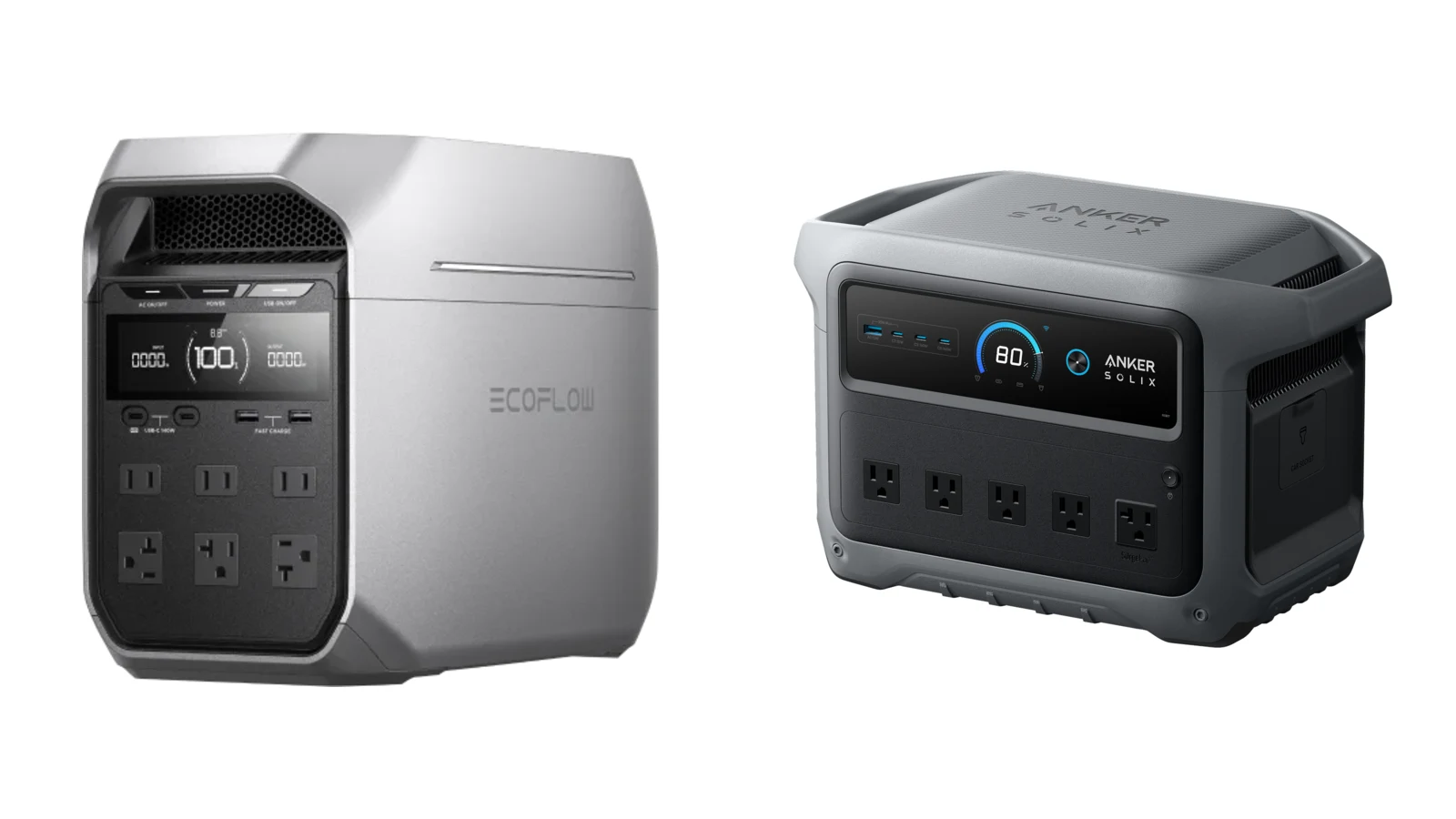
EcoFlow vs Anker specifications that change the decision
| Decision | EcoFlow DELTA 3 Plus | Anker C1000 Gen 2 | Buying consequence |
|---|---|---|---|
| Battery capacity | 1,024Wh LFP | 1,024Wh LFP | Nameplate capacity is tied; usable AC energy is lower on both |
| Rated continuous AC | 1,800W | 2,000W | Anker has the higher published continuous ceiling |
| AC outlets / total outputs | 6 / 13 | 5 / 10 | EcoFlow connects more devices without a separate power strip |
| Maximum solar input | 1,000W across two 500W inputs | 600W | EcoFlow has the stronger large-array path |
| Capacity expansion | Up to about 5kWh; battery-specific XT150 cable required | No | EcoFlow is the choice when the system may grow |
| Fastest wall-charge claim | 56 minutes at up to 1,500W | 49 minutes at up to 1,600W in app-enabled UltraFast mode | Both are fast; Anker's headline requires the special mode |
| UPS transfer claim | Below 10ms | 10ms | Neither is zero-transfer; verify sensitive equipment |
| USB-C | Two ports up to 140W | Two 140W ports plus one 15W USB-C | Both provide up to 140W USB-C PD for compatible laptops |
| Weight | 27.6 lb | 24.9 lb | Anker saves 2.7 lb for repeated carrying |
| Dimensions | About 16 × 8 × 11 inches | 15.12 × 8.19 × 9.61 inches | Anker is about 0.6 in shorter in length and 1.6 in lower, though roughly 0.2 in deeper |
| Built-in light | No | No | Keep a separate rechargeable light in an outage kit |
Calculate runtime before you buy
The 1,024Wh battery rating is stored energy, not guaranteed AC energy at the outlets. The inverter, cooling, display, radios, and internal electronics consume some power. StorageReview measured 910Wh from the EcoFlow in its AC discharge test. Separate Anker tests measured 850Wh around a 250W load and 890Wh under a different procedure.
Those numbers aren’t a controlled head-to-head. The meters, regions, loads, and test methods differ. The useful planning rule is simpler: start with 850Wh as a conservative AC budget, then divide by the average watts of everything running at the same time.
Runtime worksheet
850 usable watt-hours ÷ average device watts ≈ planning runtime
- 1. Measure the combined average load with a plug-in energy meter.
- 2. Include the router, modem, chargers, lights, or other devices running at the same time.
- 3. Divide 850Wh by that average wattage.
- 4. Reduce the answer for inverter idle draw, startup surges, temperature, battery age, and cycling loads.
The examples below are math, not product promises. Refrigerators, pumps, heating equipment, and CPAP machines cycle or have safety requirements. Measure the actual device and follow its manufacturer's backup guidance.
| Example average load | 850Wh ÷ load, before extra margin |
|---|---|
| 25W networking load | 34 hours before additional margin |
| 75W laptop-and-monitor load | 11.3 hours before additional margin |
| 150W average load | 5.7 hours before additional margin |
| 600W cooking or tool load | 1.4 hours before additional margin |
| 1,200W heater-like load | 0.7 hours before additional margin |
Check the two 1,024Wh standalone stations
Paid links. Gearsentials may earn a commission from purchases.
Neither standalone offer includes a solar panel or extra battery. Confirm the selected style before ordering.
Best for: A measured load that fits a conservative 850Wh budget with enough margin for the required time. Skip if: The worksheet requires a larger battery, generator input, or a circuit-level home-backup system.
Use continuous output, not surge marketing
Anker publishes 2,000W rated continuous AC output. EcoFlow publishes 1,800W. Those are the numbers to use when adding the loads that may run together. Anker's 3,000W peak and EcoFlow's 3,600W surge aren’t continuous operating budgets.
EcoFlow also promotes X-Boost for higher-wattage appliances, but its own page is inconsistent about whether the ceiling is 2,200W or more than 2,600W. X-Boost can change voltage behavior and shouldn’t be treated as extra clean continuous inverter capacity for sensitive electronics. Plan around 1,800W.
Anker's higher ceiling matters for a coffee maker, induction plate, power tool, or several medium loads at once. It doesn’t automatically mean longer runtime. A 1,500W appliance can drain either battery quickly even when the inverter can start it.
Choose the lighter higher-output station
Paid links. Gearsentials may earn a commission from purchases.
This is model A1763, not the expandable original C1000 A1761 or retail-channel C1000X Gen 2 A1765.
Best for: Frequent carrying, a self-contained 1kWh setup, or loads that benefit from the 2,000W rated continuous ceiling. Skip if: You need capacity expansion, more than 600W of solar input, or more than five AC outlets.
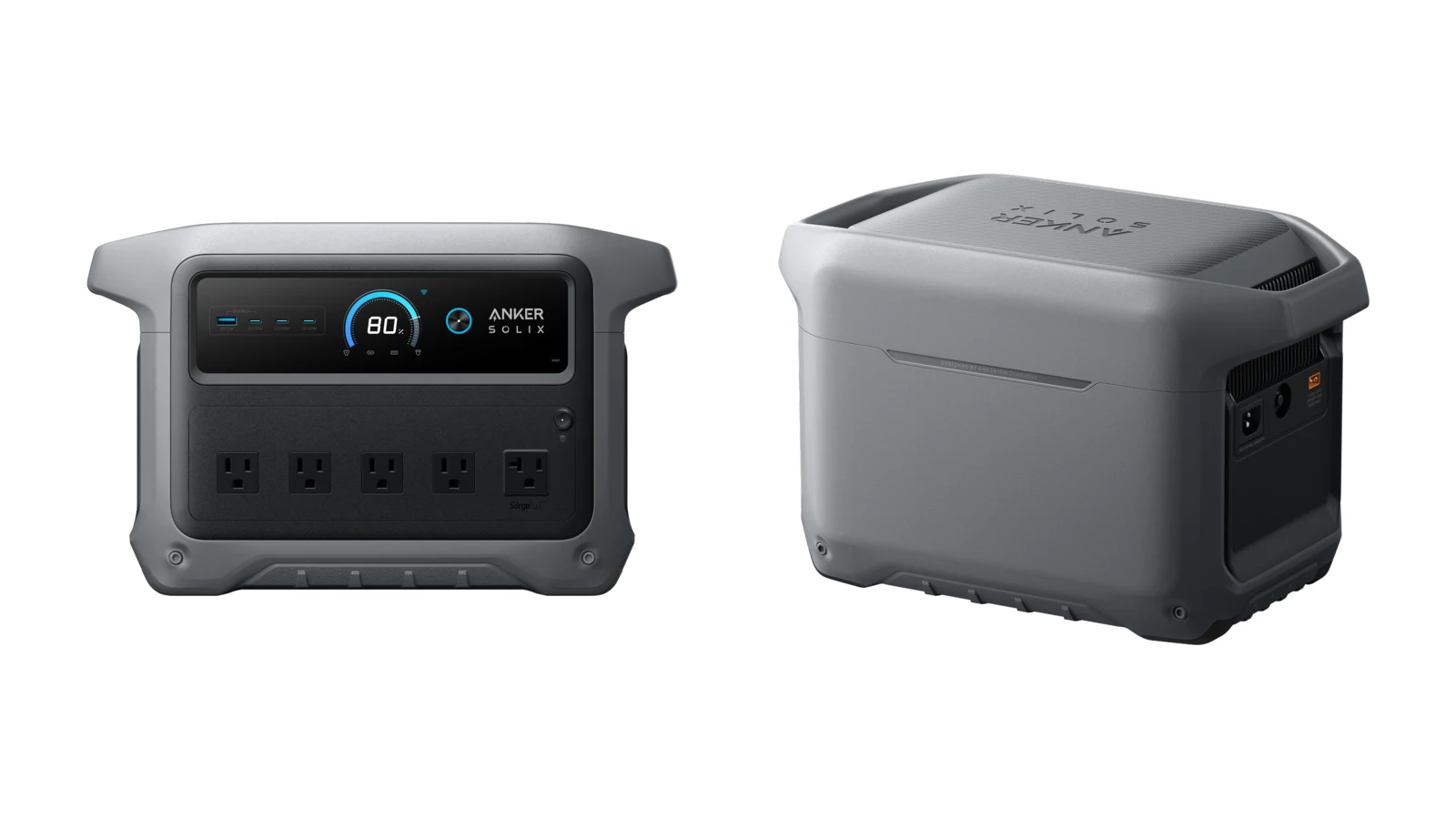
EcoFlow has the more flexible output layout
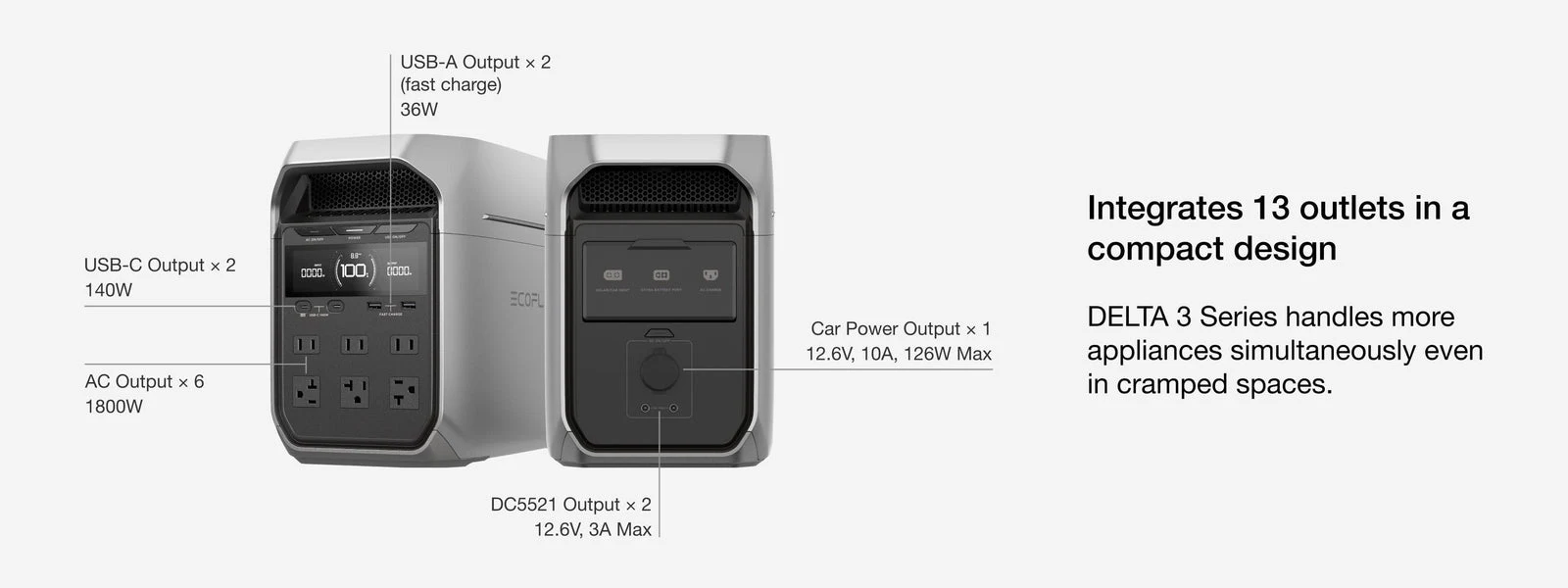
EcoFlow has six AC outlets, two USB-C ports rated up to 140W, two fast-charge USB-A ports, one car socket, and two DC5521 outputs. That’s thirteen outputs in total. Anker has five AC outlets, three USB-C ports, one USB-A port, and one car socket.
Port count matters when an outage kit includes a refrigerator, networking, laptops, phones, lights, and battery chargers. It does not increase the 1,800W EcoFlow power ceiling. Add the watts of every active device, and avoid daisy-chaining power strips just to make the layout look more capable.
EcoFlow is the stronger solar and expansion platform
DELTA 3 Plus has two solar inputs rated for up to 500W each. Anker accepts up to 600W. A large compatible array can therefore refill EcoFlow faster in good conditions, while two inputs make it easier to divide the array around voltage and current limits.
Don’t convert the headline into a guaranteed field time. Panel angle, clouds, heat, shade, cable loss, and array voltage all reduce real input. EcoFlow's 70-minute solar claim assumes ideal 1,000W conditions; the standalone Amazon offer doesn’t include panels.
EcoFlow also supports several compatible extra batteries for a documented total up to about 5kWh. The required XT150 cable depends on the battery model, so verify the exact EcoFlow cable before buying. No extra battery or expansion cable is included with the standalone station. Anker's C1000 Gen 2 doesn’t expand at all.
Choose the expandable higher-solar platform
Paid links. Gearsentials may earn a commission from purchases.
This is the standalone EF-DL-H10-4. A compatible extra battery and its required XT150 cable are separate; the offer also excludes solar panels and an alternator charger.
Best for: Larger solar arrays, a system that may grow beyond 1kWh, or a setup that needs six AC outlets and thirteen outputs. Skip if: You want the lighter self-contained unit and will never add expansion hardware or more than 600W of solar.
Both recharge quickly, but the modes differ
EcoFlow claims a full wall charge in 56 minutes with up to 1,500W AC input. Independent testing by Popular Mechanics and The Solar Lab landed around 55 minutes. Anker lists normal AC charging at 1,200W and UltraFast charging at up to 1,600W.
Anker's 49-minute headline requires enabling UltraFast mode in the Anker app and using its standard AC cable. Independent tests measured roughly 55 to 56 minutes in the normal mode and 49 minutes in UltraFast. That makes both quick in practice; the Anker marketing number isn’t the out-of-box default behavior.
Fast charging also means fan noise and a large wall draw. A Notebookcheck test measured the Anker around 45dB at one meter during higher output or fast charging. If the station lives in a quiet bedroom or office, use the app to lower charging speed when the extra minutes don’t matter.
UPS mode is useful, but it isn’t zero-transfer
EcoFlow publishes a transfer below 10ms; StorageReview measured just over 8ms. Anker publishes 10ms. A transfer around 10ms may fall within the hold-up tolerance of some routers, computers, and NAS power supplies, but it isn’t equivalent to an online UPS and doesn’t establish compatibility for a specific device.
Don’t guarantee either unit for medical equipment or every sensitive power supply. Check the connected equipment's allowable transfer time, keep the load within bypass limits, and test a noncritical shutdown before relying on the setup.
Neither belongs in the rain
EcoFlow's IP65 language applies to the internal battery pack, not the exposed power station and its outlets. Anker doesn’t publish an exact IP rating for the C1000 Gen 2. Use both under cover, keep the ports dry, and leave clearance for cooling.
Confirm the exact model before ordering
EcoFlow's Amazon family contains standalone units, extra-battery bundles, solar bundles, alternator-charger bundles, and adjacent DELTA models. The link in this guide is ASIN B0DCC2BVFW for the standalone DELTA 3 Plus model EF-DL-H10-4.
Anker's naming is easier to mix up. The linked model is A1763, ASIN B0FN7MSY4L. The original A1761 C1000 has 1,056Wh and accepts an expansion battery. The C1000X Gen 2 A1765 is a separate retail variation. A cheaper adjacent listing isn’t automatically the product evaluated here.
Who should buy each power station?
Buy the Anker SOLIX C1000 Gen 2 when:
- You’ll carry the station often and 2.7 pounds matters.
- A 2,000W rated continuous ceiling better fits the appliance mix.
- Five AC outlets and ten total outputs are enough.
- You want one compact 1kWh station and don’t plan to expand it.
- A 600W solar ceiling already matches the panel plan.
Buy the EcoFlow DELTA 3 Plus when:
- The solar array may grow beyond 600W.
- Compatible extra batteries could extend the system later.
- Six AC outlets or thirteen total outputs simplify the setup.
- The load remains inside the 1,800W rated continuous ceiling.
- The extra 2.7 pounds won’t change where the station goes.
The final recommendation
The Anker C1000 Gen 2 is the more focused portable tool. It’s the default recommendation for a buyer who wants one carryable 1kWh station, knows that 850Wh of planning energy fits the job, and has no expansion plan.
The EcoFlow DELTA 3 Plus is the better system foundation. Its value appears only when the extra solar input, compatible-battery path, or larger output layout is used. Buying it for a future that never arrives leaves the reader carrying more weight for the same 1,024Wh nameplate capacity.
Compare the exact standalone recommendations
Paid links. Gearsentials may earn a commission from purchases.
Confirm the model, selected style, seller, shipper, and standalone bundle contents on Amazon before ordering.
Best for: Anker for the lighter self-contained station; EcoFlow for the expandable higher-solar platform. Skip if: The selected Amazon configuration doesn’t match the exact standalone model named on the button.
FAQ
Which is better: EcoFlow DELTA 3 Plus or Anker C1000 Gen 2?
Anker is the better default when portability, a 2,000W rated continuous ceiling, and a self-contained 1kWh station matter most. EcoFlow is better when 1,000W solar input, compatible-battery expansion, six AC outlets, or thirteen total outputs changes the setup.
Can either power station run a refrigerator?
Usually, if the refrigerator's running watts and startup surge stay within the station's limits. Runtime can’t be predicted from the refrigerator label alone because compressors cycle. Measure a full day with a plug-in energy meter, then compare that watt-hour use with a conservative usable-energy budget.
How long will a 1,024Wh power station run my equipment?
Use 850Wh as an illustrative AC planning budget, not guaranteed usable energy. Divide it by measured average watts, then add margin for low-load inverter draw, startup surges, temperature, battery age, and cycling loads.
Can the Anker SOLIX C1000 Gen 2 use an expansion battery?
No. Anker says the A1763 C1000 Gen 2 can’t expand. The original A1761 C1000 is a different 1,056Wh model that supports an expansion battery, which is why the exact generation matters.
Can the EcoFlow DELTA 3 Plus expand beyond 1,024Wh?
Yes. EcoFlow lists DELTA 3, DELTA 2, DELTA 2 Max, and DELTA Pro 3 extra batteries as compatible, for total capacity up to about 5kWh. The required XT150 cable depends on the battery model, so verify the exact EcoFlow cable before buying. No extra battery or expansion cable is included with the standalone station.
Are these replacements for a traditional UPS?
Both publish transfer times around 10ms, and StorageReview measured just over 8ms on the EcoFlow. That isn’t zero-transfer power and doesn’t guarantee compatibility with every workstation, medical device, or other sensitive load. Follow the equipment manufacturer's backup guidance and test noncritical devices first.
Do the standalone Amazon offers include solar panels?
No. The exact ASINs linked in this guide were verified as standalone power stations, not solar or extra-battery bundles. Amazon groups many configurations together, so confirm the selected style before ordering.
Sources
- EcoFlow DELTA 3 Plus product page and US specifications
- EcoFlow DELTA 3 Series product overview and configuration page
- EcoFlow DELTA 3 Plus user manual and technical specifications
- Anker SOLIX C1000 Gen 2 product page and specifications
- Anker SOLIX C1000 Gen 2 support and manual page
- Anker official C1000 Gen 2 expansion answer
- StorageReview EcoFlow capacity and UPS testing
- Notebookcheck Anker capacity, recharge, and noise testing
- OutdoorGearLab Anker usable-energy and charge testing
- MacRumors Anker US port and long-term use observations
- Popular Mechanics EcoFlow recharge testing
- The Solar Lab EcoFlow recharge and high-load testing